


NYC DOT Begins BQE Environmental Review for $4 Billion Reconstruction
Enjoying the coverage?
Construction, resiliency and infrastructure projects in one Friday email. Free; unsubscribe in one click.
Sent every Friday. By subscribing, you agree to our Terms of Use and Privacy Policy.
The Short Version
- The Department of Transportation initiated an environmental review for its $4 billion BQE Central reconstruction plan on Monday.
- The project aims to rehab a deteriorating section of the BQE between Atlantic Avenue and Sands Street over the next decade.
- A temporary bypass is proposed, which has drawn significant criticism from Brooklyn residents.
- Public feedback is being gathered as part of the required environmental impact statement process.
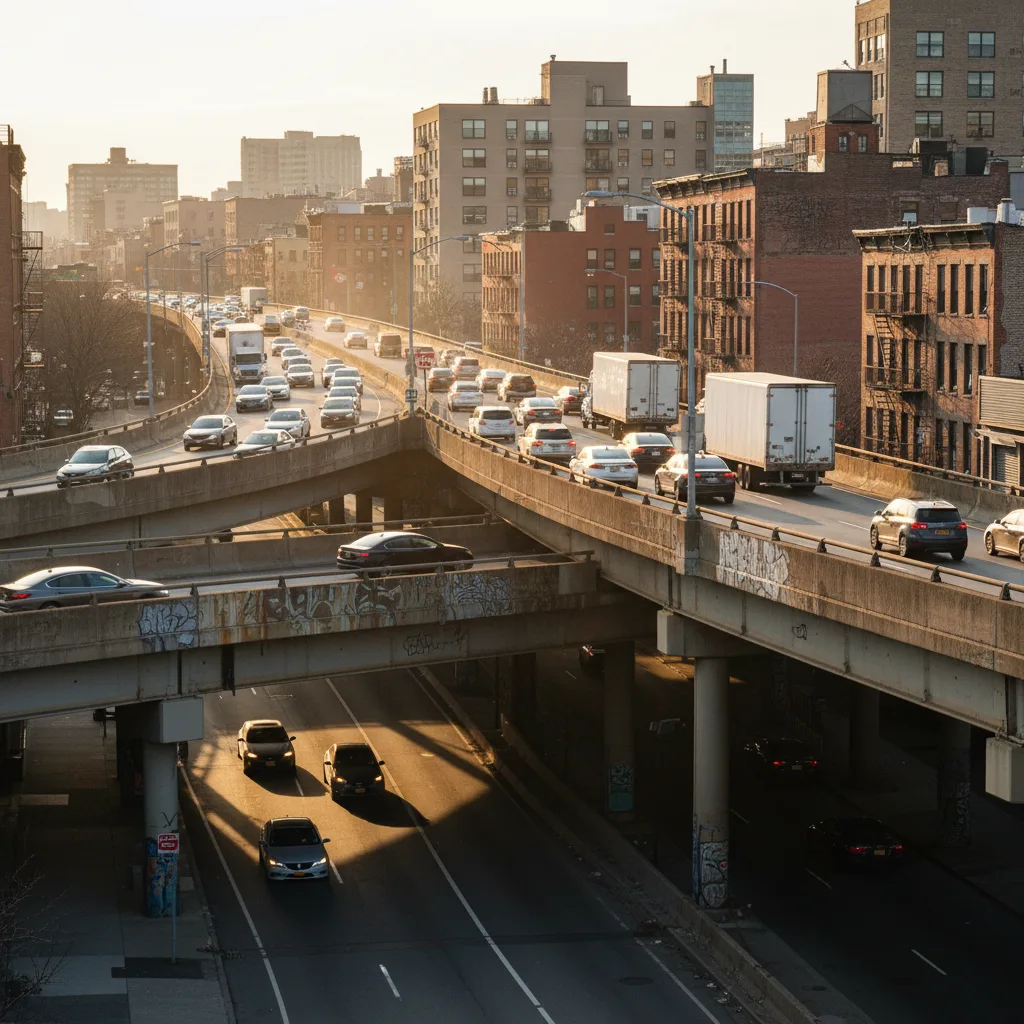
NEW YORK — The Department of Transportation (DOT) began gathering feedback on Monday for a required environmental review concerning its $4 billion proposal to reconstruct a central section of the Brooklyn-Queens Expressway (BQE). This major project targets the deteriorating highway stretch located between Atlantic Avenue and Sands Street in Brooklyn.
The Cross Bay News Friday Briefing
Construction, resiliency and infrastructure projects in one Friday email. Free; unsubscribe in one click.
Sent every Friday. By subscribing, you agree to our Terms of Use and Privacy Policy.
BQE Central Project Focuses on Critical Infrastructure Needs
The DOT's plan, dubbed "BQE Central," aims to address the structural integrity and long-term sustainability of this vital transportation artery. The section of highway in question has been a growing concern for city officials and engineers due to its advanced state of disrepair. The current proposal outlines a comprehensive rehabilitation effort slated to span the next decade, according to Streetsblog New York City.
Engineers and urban planners have long highlighted the urgent need for upgrades to the BQE, citing safety concerns and the potential for significant disruption if the highway were to fail. The project is designed not just to repair but to modernize this crucial link in the city's infrastructure network. This includes evaluating alternative designs to enhance traffic flow and pedestrian access.
Brooklyn Residents Oppose Temporary Bypass Plan
A central component of the DOT's proposal involves constructing a temporary bypass to maintain traffic flow during the multi-year construction period. This aspect has already ignited strong opposition from Brooklyn communities, who express concerns about its potential impact. Residents fear increased noise, pollution, and disruption to local neighborhoods, particularly those adjacent to the proposed bypass route.
The feedback collection process is a critical step in the environmental review, allowing community voices to be heard before final plans are solidified. Many Brooklynites have voiced their disapproval of the temporary bypass, suggesting it could create more problems than it solves for the densely populated areas it would traverse, as reported by Streetsblog New York City.
Community Input Essential for Environmental Impact Statement
The environmental review process requires the DOT to produce an Environmental Impact Statement (EIS), a detailed document assessing the project's potential effects on the environment and surrounding communities. Gathering public feedback is an integral part of this process, ensuring that diverse perspectives are considered. Community meetings and public comment periods are being organized to facilitate this input.
This early stage of public engagement aims to identify key concerns and potential solutions that might mitigate negative impacts. The agency is mandated to take this feedback into account when refining its plans and preparing the final EIS. Transparency in this process is crucial for fostering public trust and ensuring a project that serves the broader community effectively.
Historical Context of BQE Challenges and Prior Efforts
The BQE has a long history of maintenance challenges and previous attempts at repair and redesign. Originally constructed in the mid-20th century, parts of the highway were not built to withstand the volume and weight of modern traffic. Past efforts to address these issues have often faced significant public and political hurdles, reflecting the complexity of urban infrastructure projects.
The section through Brooklyn Heights, for example, saw a controversial cantilever structure built to preserve the Promenade. This current $4 billion rehabilitation proposal is the latest in a series of ambitious plans to tackle the BQE's aging infrastructure. It builds on decades of discussions about how to balance the needs of regional transportation with local community quality of life.
Future Stages of the BQE Central Project
Following the completion of the environmental review and the publication of the EIS, the DOT will proceed with further design development and securing necessary approvals. The project's timeline suggests that actual construction would begin several years from now, extending over a decade. This long-term commitment requires sustained public engagement and adaptive planning.
The agency will continue to work with community boards, local elected officials, and advocacy groups throughout the various phases of the project. The goal is to deliver a rehabilitated BQE that is safe, efficient, and minimizes adverse impacts on adjacent neighborhoods, particularly those along Cross Bay Boulevard in Queens, where traffic impacts are often felt from major Brooklyn infrastructure projects.
What the Reports Don't Say
- The specific locations of all proposed temporary bypass access points and their projected traffic volumes are not yet fully detailed.
- The exact funding mechanisms for the $4 billion project beyond initial environmental review phases have not been fully disclosed.
Sources
Compiled by the Cross Bay News Desk from the sources listed below with AI assistance.
- [Reporting] Highway or the Highway: Brooklynites Slam BQE Bypass Proposal - Streetsblog New York City: Streetsblog New York City
Frequently Asked Questions
What is the primary purpose of the BQE Central project?
The primary purpose of the BQE Central project is to rehabilitate a deteriorating section of the Brooklyn-Queens Expressway between Atlantic Avenue and Sands Street, addressing structural integrity and modernizing the highway for long-term use. The Department of Transportation is undertaking this multi-billion dollar effort to ensure the safety and efficiency of this critical urban thoroughfare.
How can residents provide feedback on the BQE bypass proposal?
Residents can provide feedback on the BQE bypass proposal through public meetings and comment periods organized by the Department of Transportation as part of the required environmental review process. These forums are designed to gather community input, which will inform the Environmental Impact Statement and subsequent project decisions.
Written by
Cross Bay News Staff
Cross Bay News
The Cross Bay News Friday Briefing
Construction, resiliency and infrastructure projects in one Friday email. Free; unsubscribe in one click.
Sent every Friday. By subscribing, you agree to our Terms of Use and Privacy Policy.
Related Articles
More in Development & Infrastructure →
NYC DOT Redoes Cross Bay Boulevard Paving in Broad Channel
The NYC Department of Transportation began redoing repaving work on Cross Bay Boulevard in Broad Channel in November 2026 to correct substandard prior efforts.
NYC DOT Begins Redoing Shoddy Cross Bay Boulevard Repaving in Broad Channel
The NYC Department of Transportation initiated new repaving efforts on Cross Bay Boulevard in Broad Channel in November 2026 to correct substandard previous work.
Rego Park Residents Concerned Over Cross Bay Boulevard Plans
Rego Park residents are concerned about large-scale development plans along Cross Bay Boulevard, raising questions about infrastructure and traffic.
Cross Bay Boulevard Alteration Permit Issued for 156-40E Queens
An alteration permit has been issued for 156-40E Crossbay Boulevard in Queens, NY 11414, with the DOB status now reading "permit entire."
Cross Bay Boulevard Development Plans Spark Concern in Rego Park
Residents along Cross Bay Boulevard, Queens, are concerned about how large-scale development plans could affect surrounding areas like Rego Park.
Deputy Speaker Williams Forms Downtown Jamaica Oversight Task Force
Deputy City Council Speaker Nantasha Williams announced plans on Monday, November 10, 2026, for a Downtown Jamaica Oversight Task Force to monitor redevelopment efforts.